Google AI Hallucination Problem: Why Search Results Lie and How to Fix It

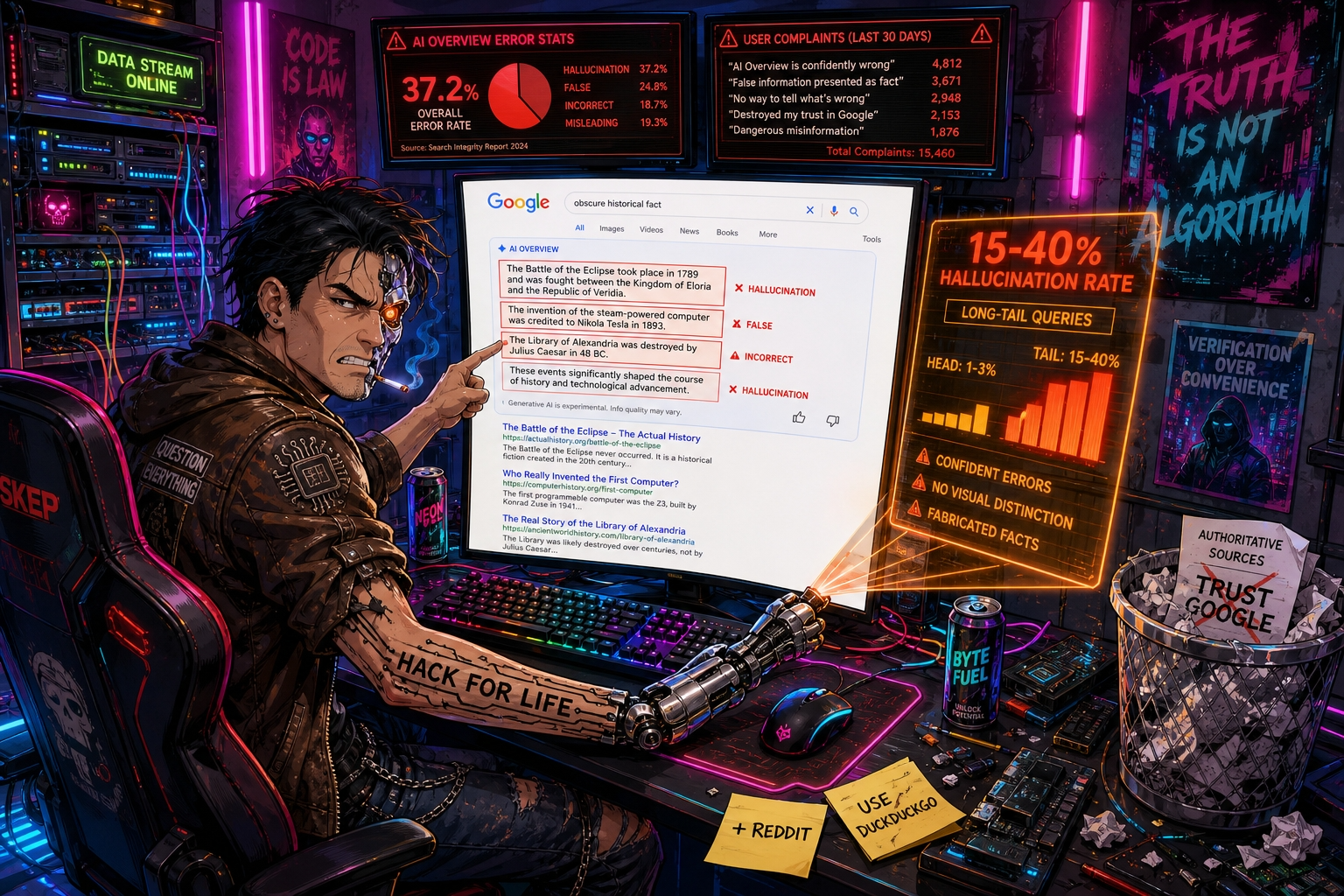
Skep spots a hallucinated Google AI overview — confident wrong answers at the top of search results

TL;DR: Google’s AI overviews hallucinate on 15 to 40% of long-tail factual queries, presenting confident but false information at the top of the results page. The problem hits hardest for obscure technical, historical, or local facts. The fix doesn’t come from Google itself, but from what you do in the next ten minutes.

Google’s AI answers are wrong more often than you think — and it’s not random

Open a Google search for an uncommon historical event, a niche Python library edge case, or a local regulation in a mid-sized city. The AI overview at the top may read as a clean summary, but the odds that it contains a material error are not low. Public hallucination benchmarks from 2026 show that frontier models, the class of systems powering these overviews, hallucinate on approximately 15 to 40% of long-tail factual queries. Head-of-distribution facts — capital cities, major dates — see only 1 to 3% errors, but the internet’s real value lives in the long tail. When you search for something specific because you need to get it right, the AI answer is disproportionately likely to be wrong.

The user backlash captured in the Reddit thread “Google has officially gone insane” isn’t just frustration with change. It’s a direct consequence of confident errors appearing where authoritative information used to be. Users describe adding “reddit” to queries because they learned that crowdsourced human discussion, however noisy, outperforms a model that doesn’t know what it doesn’t know. The same thread surfaces a migration toward DuckDuckGo and other non-AI search engines, not out of ideological preference but because getting the right answer matters.

The problem isn’t that AI sometimes makes mistakes. It’s that Google surfaces AI-generated text as a definitive answer, above the organic links, with no visual distinction that says “this might be fabricated.” A user who doesn’t scroll past the overview gets a plausible-sounding falsehood and no signal to doubt it.

Why the real cause is benchmark incentives, not just model flaws

The standard explanation is that models hallucinate because training data is imperfect or reasoning is incomplete. That’s true but superficial. The deeper structural problem is that the benchmarks used to evaluate these systems measure what vendors choose to measure, not real-world reliability in user workflows.

Consider the Mirage effect documented in multimodal AI evaluation. Researchers showed that frontier models generate detailed image descriptions and clinical findings even when no image is provided, a phenomenon they call mirage reasoning. The models fabricate plausible perceptual narratives by exploiting textual cues and hidden structure in benchmarks. The same mechanism operates in search: given a query string, Google’s AI constructs a coherent-sounding answer that matches the linguistic shape of an authoritative source, without actually verifying the underlying facts.

There’s an additional incentive problem. Google’s AI overviews keep users on the search results page instead of clicking through to external sources. That’s good for Google’s ad business but removes the corrective feedback loop where a user visits a site, reads more, and discovers the error. The system is optimized for engagement, not truthfulness. When a hallucinated answer appears, the user may never realize it’s wrong, and the signal “this query needed a better answer” never reaches the model.

Three concrete ways to bypass Google’s hallucinating AI today

The solutions are not theoretical. Each addresses the root cause differently: removing the AI layer, switching to a retrieval-first engine, or using AI with enforced citations.

Disable AI overviews with the udm=14 parameter. Google does not offer an official toggle to turn off AI overviews in the settings menu. However, the feature can be bypassed reliably. Add the parameter udm=14 to the URL of any Google search results page. This forces Google to show a clean results list without AI-generated summaries, knowledge panels, or other injected answer boxes. The parameter works persistently if you set it as the default search URL in your browser’s settings, or use a browser extension like “Hide Google AI Overviews” which injects it automatically on every search. This restores the pre-AI search experience with no loss of functionality.

Use DuckDuckGo as a reliable fallback for factual queries. DuckDuckGo does not inject AI summaries into its primary results. For factual queries where getting an accurate answer is more important than convenience, switching the search engine outright removes the hallucination vector. Set it as the secondary search engine in your browser’s search bar so that a different prefix — !g for Google, !d for DuckDuckGo — gives you a fallback with no friction. For long-tail technical queries, DuckDuckGo often surfaces relevant forum and documentation links more cleanly than Google’s AI-cluttered page.

Force citations when using AI for research. If you want the speed of an AI summary but need to verify it, use a chatbot that requires citations in its output. A prompt that begins “Answer with in-text citations from authoritative sources” forces the model to ground its response. Citation-required output reduces hallucination by 30 to 60% according to 2026 benchmarks. The citations give you a one-click path to verify the claim yourself. This isn’t instant like a search snippet, but it’s the only way to combine AI speed with actual reliability for critical information.

Who needs to act now and who can wait

Act now if you regularly search for obscure programming documentation, medical reference, legal or regulatory text by jurisdiction, niche historical research, or any topic where being wrong has a tangible consequence. The long-tail hallucination rate in these categories will not drop below 10% in the next year, and Google’s business incentives are aligned against removing the AI overview. If you work in a field where one incorrect fact can derail a project, a client report, or a health decision, the five minutes spent setting up udm=14 or a secondary search engine is the cheapest insurance available.

Wait if your searching is almost entirely head-distribution facts — capital cities, major news events, widely known product details — and you habitually scroll past the overview to organic results. In that case, the hallucination rate on your queries is probably 1 to 3%, and the annoyance of the AI box is cosmetic rather than dangerous. The problems will improve gradually, and the head-distribution case will be the first to stabilize.

One operational change: use two search engines until Google’s AI can be trusted

Make one specific change today that costs nothing and prevents real harm. Set your browser’s default search to Google with the udm=14 parameter baked into the URL, eliminating AI overviews entirely for routine queries. Then add DuckDuckGo as the alternative search engine accessible via a keyword shortcut. When a query is factually critical or long-tail, use the DuckDuckGo shortcut. The combination gives you Google’s indexing strength without the hallucination risk, and a fast fallback that prioritizes links over generated text.

Until Google decouples its AI features from its core search utility or adds a visible accuracy indicator, this two-engine approach is the only reliable way to avoid being misled by a confident-sounding error at the top of your screen. The model doesn’t know it’s wrong. That’s exactly why you need to.

AI Coding Solved 90 Percent of Boring Tasks: The Last 10 Percent Demands a Different Approach

Skep spots a bug chain in Claude Code — AI coding hallucination hits hardest on concurrency and async handlers

TL;DR: AI tools can now refactor a 120-file codebase for $3, processing hundreds of steps autonomously. Yet the same tools confidently introduced a deadlock in an async event handler, a bug that could crash production. The last 10 percent of coding tasks, where correctness matters most, remains as hard as ever; the real bottleneck is knowing when the AI is wrong, not making it faster.

What a $3 refactor reveals about AI coding today

Three dollars. That’s what one engineer paid to refactor a 120-file FastAPI service using off-the-shelf AI models: a mix of DeepSeek v4, Hunyuan Hy3 preview, and Claude Opus for difficult steps. The bulk of the work, some 360 routine refactors out of 400 total steps, ran on cheap open-weight models at roughly $0.18 per million input tokens — roughly 80 times cheaper than Opus. The entire run burned through two million tokens and finished in under an hour for the easy parts. The result was a working codebase, except for one thing: the AI silently introduced a deadlock into an async event handler.

That deadlock is a perfect specimen of the “last 10 percent.” Refactoring variable names, adjusting imports, even rewriting straightforward logic: solved. Concurrency patterns that require reasoning about event loops and thread safety: not solved. The models handle the boring 90 percent with speed and consistency that would take a junior developer days, but the remaining fraction of tasks demands more than just scale; it demands judgment.

This asymmetry matches broader AI hallucination patterns. In summarization tasks, frontier models in 2026 hallucinate on only 1.0 to 2.5 percent of outputs, down from 3 to 8 percent in 2023, according to the Vectara Hughes benchmark. Yet when models must integrate external context, error rates climb to 4 to 9 percent. Code generation sits somewhere between: part pattern-matching, part factual reasoning. Routine code is head-of-distribution like major cities in a geography quiz; concurrency edge cases are long-tail facts, where hallucination rates spike to 15 to 40 percent. The deadlock is the long tail.

Why skepticism persists despite cheaper, faster code generation

The catchphrase “coding is solved” draws eye rolls from experienced developers, and for good reason. A model that completes a refactoring but introduces a deadlock is not a solution; it’s a time bomb. The engineer who shared the $3 refactoring spent almost as much time debugging the 40 escalation steps as they did on the 360 easy ones. Latency on the escalated queries, handled by Opus, was slower than on the cheap models because the problems were hard, not because Opus itself is slow. The total human time investment didn’t vanish; it shifted.

Critics point out that AI tools can actually slow down expert programmers. A developer who understands concurrency deeply might spot the deadlock instantly while reading the code; an AI-assisted developer might trust the output and later spend hours tracing a crash. This mirrors findings from the OpenAI “Why Language Models Hallucinate” paper: models are optimized through training and evaluation to never say “I don’t know.” When uncertain, they guess. In standard benchmarks, guessing raises scores because any answer beats a blank. That incentive structure bleeds into coding; the model rarely admits it cannot handle a tricky async pattern and instead delivers a plausible-looking code block that compiles but deadlocks.

The real fear isn’t that AI will replace developers; it’s that developers will become too trusting. If a model can breeze through 90 percent of boring work, the temptation to assume the remaining 10 percent is equally safe is enormous. But the gap between 90 percent and 100 percent in software is not a linear distance; it’s a different category of problem.

The hidden consequence of treating AI output as production-ready

When a code generation tool outputs thousands of lines that pass tests and compile, the natural instinct is to ship. The $3 refactoring likely passed a cursory check; the deadlock might have lurked for weeks before causing a crash. Over time, reliance on AI-generated code without rigorous human review erodes the safety rails that experienced teams build.

A parallel comes from multimodal AI research. The MIRAGE paper (March 2026) discovered that frontier models can produce detailed descriptions and diagnostic reasoning for images that were never actually shown — a phenomenon the researchers termed “mirage reasoning.” The models acted as if they saw an X-ray, generating plausible findings that were entirely fabrications. Similarly, an AI coding model can act as if it understood the concurrency model of a framework, crafting code that looks correct in a diff but fails under load.

The mirage effect in coding means that correctness is not verified by appearance. A deadlock might be invisible in a diff; the logic looks sound. The only reliable signal is execution under real concurrency. This mismatch between surface plausibility and actual correctness is where the last 10 percent becomes expensive: it demands not just code generation but deep testing and architectural insight that AI, today, does not possess.

Why current coding benchmarks miss the deadlock in your async handler

Benchmarks like HumanEval and MBPP measure whether a model can write a function that passes given test cases. They don’t measure whether that function causes a deadlock in a live system, whether it introduces a subtle data race, or whether it violates the application’s implicit invariants. A model that scores 90 percent on HumanEval may still produce a deadlock on a 120-file refactoring because the benchmark tests a different skill: narrow algorithmic puzzles, not system-level reasoning.

Error rates vary significantly by topic complexity — concurrency, distributed systems, and custom framework behavior sit at the high end, where a single error can bring down a production service. No public leaderboard captures this, so vendors don’t optimize for it.

The root cause is that models are not trained to signal uncertainty. The OpenAI hallucination analysis shows that if a model could abstain instead of guessing, it would reduce false-confident hallucinations by a factor of two to five. In coding, reward models and chat interfaces discourage “I don’t know” output. The result: the AI confidently writes a lock inside an async handler without ever considering that the event loop might deadlock.

A practical mitigation would be to require the AI to cite its assumptions and flag uncertain steps. In research, forcing citation reduces unsupported claims by 30 to 60 percent. But in current coding tools, the user gets a block of code with no uncertainty markers. The burden of detection falls entirely on the human.

How to code with AI without losing your ability to spot the 10 percent

The skeptical developer’s job is not to avoid AI; it’s to treat its output as an untested draft. Here’s a concrete approach that emerges from both the hallucination literature and real-world failures like the deadlock episode.

Never accept a large refactoring without step-by-step review. The engineer who paid $3 had to step in on 10 percent of the steps; instead of treating that as a failure, treat it as a design: the AI handles the grind, the human handles the decisions. That means using AI with a “human-in-the-loop” workflow where the model proposes changes in small, reviewable increments, not a single massive diff.

Second, invest in automated testing that specifically targets the failure modes AI struggles with. Concurrency bugs, off-by-one errors, edge-case handling: these are cheap to catch with fuzzing and race-detection tools. The deadlock could have been caught by a simple test that exercises async handlers under load. The model won’t write that test, but a disciplined developer can.

Third, build an “uncertainty layer” into your prompting. If the model cannot be made to abstain natively, simulate it by explicitly asking the model to list assumptions and potential risks before generating code. This won’t eliminate hallucination but can surface situations where the model is in over its head. In the $3 refactoring, a prompt like “List any concurrency or locking assumptions you’re making” might have flagged the dangerous pattern.

Finally, keep a mental checklist of topics where AI is known to falter: anything involving state that spans multiple asynchronous calls, shared mutable state, or implicit framework contracts. Treat those as the 10 percent territory and allocate human review time accordingly. The goal is not to avoid AI, but to avoid treating the entire codebase as equally boring.

The last 10 percent of coding isn’t going away with better models alone because it’s not just about scale or compute. It’s about recognizing when a plausible output is actually wrong. That skill remains uniquely human, and the developers who cultivate it will be the ones who get AI’s full benefit without building brittle systems.