
Meta’s Internal Anti-AI Video Is a Warning About Forcing Employees to Train Their Own Replacements

Skep prepares purple vials while his monitor shows "Training Your Replacement 94%" — Meta's forced AI training program turns employees into data poisoners

TL;DR: Meta reassigned 7,000 employees to train the AI replacing their laid-off colleagues. The result: a parody video, calls to poison the data, and a model that will hallucinate exactly where humans were most valuable.

When morale collapses, the training data collapses with it.

When Meta laid off 8,000 workers and reassigned another 7,000 to train AI models, a departing engineer posted a parody video set to “American Pie” on the company’s internal message board. The video captured a sentiment that had been simmering for weeks: you are being asked to build the thing that will make you redundant. The clip’s popularity was not just a morale collapse. It was the visible tip of a practical problem companies rarely acknowledge. Forced AI training mandates, combined with large-scale layoffs, create the conditions for unreliable training data and models that fail in ways nobody is measuring.

The real risk is not that employees will quietly comply. It’s that resentment turns into deliberate data poisoning, or equally corrosive, that demoralised workers stop surfacing the errors the model inevitably makes. Once the models are deployed, the business inherits a system that looks competent on a dashboard but hallucinates on the exact tasks that used to require human judgment. The fix is not better model cards or more alignment research. It’s a set of defensive moves that employees can take right now without resorting to sabotage.

The numbers behind the video: 8,000 layoffs, 7,000 reassignments, one pipeline.

Meta’s spring 2026 restructuring was extreme but not unique. The company explicitly tied the headcount reduction to a strategic pivot toward AI, and hundreds of the retained employees were moved into roles where their daily output would directly train the models intended to absorb their former colleagues’ work. The internal message board began filling with calls to “confuse the AI,” feed it false information, and trigger infinite recursion loops. A software engineer named David Frenk posted a farewell video set to the chords of “American Pie” and it spread instantly, becoming a rallying point.

The practical problem hits the machine learning pipeline immediately. Training data from workers who resent the project carries a higher noise floor. But even when employees stay honest, the mechanism of forced participation erodes a subtle safety net: the informal feedback loops that catch edge-case failures during normal operations. When people stop caring because they believe the model is there to eliminate them, they stop correcting it. The business is then flying blind, substituting the false confidence of a leaderboard metric for the messy reality of work.

The deeper reason forced AI training backfires: language models are built to guess, not to admit ignorance

Most commentary treats this as a labour relations story. The more consequential layer is technical. Large language models hallucinate because their training and evaluation pipeline treats a guess that sounds plausible as better than a refusal to answer. In pretraining, any incorrect statement that matches the statistical shape of a fact is rewarded if it minimises cross-entropy loss. In post-training, the dominant benchmarks use 0-1 scoring: a wrong answer and a hesitant “I don’t know” are equally penalised, so the model learns to produce confident-sounding outputs even when uncertainty would be the accurate response. This is the same guessing mechanism that drives AI moderation false positives — the model never learned to say it doesn’t know.

When a company asks the very people who understand the domain to train the replacement model, the hope is that those workers will inject precision. But the incentive structure of the model itself pushes toward overconfidence. Employees know the edge cases. The model, rewarded for guessing, will paper over them with fluency.

Data on hallucination rates backs this up. On summarisation benchmarks, the best frontier models in 2026 still hallucinate on about 1.0 to 2.5 percent of outputs. On tasks that require integrating retrieved context with internal knowledge, the rate jumps to 4 to 9 percent. And for long-tail facts, exactly the kind of niche, company-specific details that an internal model would need to nail, hallucination rates sit at 15 to 40 percent even on the most capable systems. A model trained under duress on the tacit knowledge of staff who are being shown the door will inherit those error rates, and the errors will land precisely where the human was most valuable.

What workers can do when asked to train their own AI replacement

Sabotage is not a solution. Deliberately poisoning data is detectable, often illegal, and ultimately makes the model worse in ways that hurt the people still using it. Three practical alternatives give employees leverage without ethical or legal exposure.

Document the model’s failure modes instead of sabotaging it. Every time the internal AI generates an output that is factually wrong, misattributes a source, or draws a false connection, record it. Create a simple log with the prompt, the model’s response, and what the correct answer should be. This is not obstruction. It is the quality assurance step the business claims to want. A growing catalogue of concrete errors shifts the conversation from “the model is generally capable” to “here are the 47 tickets it got wrong last week.” A well-maintained failure log makes the case for human-in-the-loop oversight in terms the organisation understands: cost of error.

Shift your work toward decisions the model isn’t rewarded to make. The same evaluation structures that reward guessing also leave a gap: whenever the correct answer requires surfacing doubt, checking a citation, or abstaining, the model underperforms. If your role involves deciding when to trust a source, verifying a chain of reasoning, or determining that a question is unanswerable with current information, you are operating in the space where models are most brittle. Make that portion of your work explicit. Write down the judgment calls the AI cannot make and tie them to concrete business outcomes.

Treat the AI as an unreliable junior, not a replacement. Forced-ranking a human against a language model rarely makes sense when the model hallucinates on internal data. The most defensible posture is to treat the AI as a first-draft tool that must be checked. Propose a process where the model produces an output, a worker validates it against known ground truth, and the corrections feed back into a dataset used only to improve retrieval, not to replace the checker. This turns a threat into a collaboration that mirrors what the best-performing RAG systems already do: retrieval with high-quality sources cuts hallucination by 50 to 80 percent. The person who designs that feedback loop becomes the one the business cannot remove.

Workers in rote documentation roles feel the pressure now. Judgment-heavy roles have breathing room.

The employees most immediately exposed are those whose output is close to the training pipeline: handling routine support tickets, generating status reports, or organising inboxes. These are tasks the model can handle passably until it silently mangles a critical date or client name. In those roles, AI deployment is already underway and the need to build a failure log is urgent.

Workers in roles that depend on weighing conflicting evidence, making decisions with asymmetric downside, or interpreting ambiguous internal policy are in a slower-burning situation. The models still confidently hallucinate under those conditions because they are not penalised for guessing, and the non-deterministic nature of prompts makes the error pattern unpredictable. The transformation is real, but it is a long grind of S-curves, not a sudden singularity. The breathing room exists because the technology hasn’t smoothed out the rough edges that matter most for autonomous high-stakes work.

If your employer is deploying AI without fallback plans, your leverage lies in knowing exactly where it breaks

The Meta internal video was a flare, not the fire. The fire is the assumption that you can replace the people who built the intelligence with a system that still guesses on the hard parts. The employee who can walk into a review and say, “Here are the 30 failure cases from this month, here is what they cost, and here is the validation layer that catches them,” stops being a cost to be cut and becomes a hedge against reputational and operational damage. That is not a morale argument. It is a hard business case that the hallucination benchmarks already make. The models are not going away, but neither is the need for someone who knows exactly where they will be wrong.
AI Coding Solved 90 Percent of Boring Tasks: The Last 10 Percent Demands a Different Approach

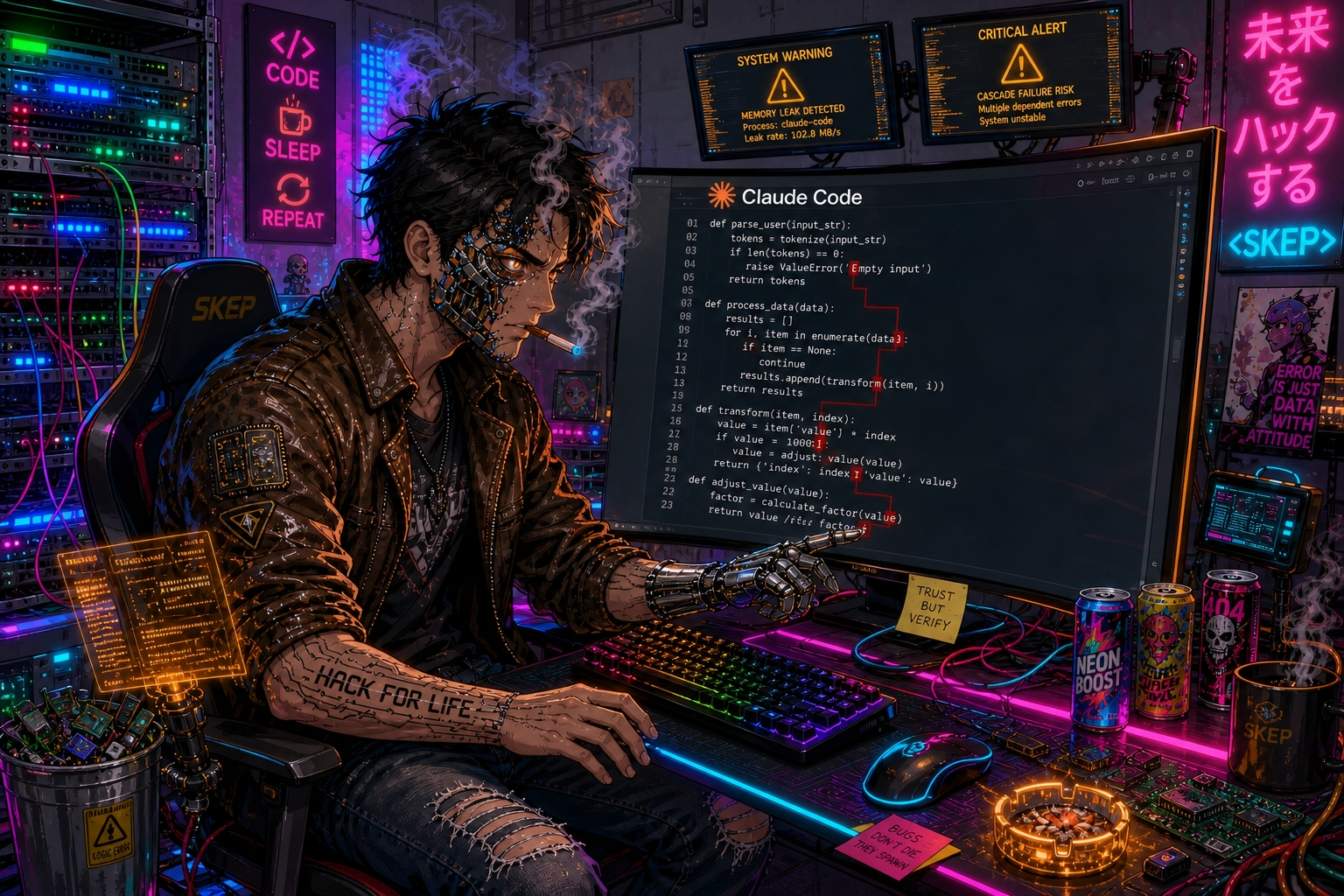
Skep spots a bug chain in Claude Code — AI coding hallucination hits hardest on concurrency and async handlers

TL;DR: AI tools can now refactor a 120-file codebase for $3, processing hundreds of steps autonomously. Yet the same tools confidently introduced a deadlock in an async event handler, a bug that could crash production. The last 10 percent of coding tasks, where correctness matters most, remains as hard as ever; the real bottleneck is knowing when the AI is wrong, not making it faster.

What a $3 refactor reveals about AI coding today

Three dollars. That’s what one engineer paid to refactor a 120-file FastAPI service using off-the-shelf AI models: a mix of DeepSeek v4, Hunyuan Hy3 preview, and Claude Opus for difficult steps. The bulk of the work, some 360 routine refactors out of 400 total steps, ran on cheap open-weight models at roughly $0.18 per million input tokens — roughly 80 times cheaper than Opus. The entire run burned through two million tokens and finished in under an hour for the easy parts. The result was a working codebase, except for one thing: the AI silently introduced a deadlock into an async event handler.

That deadlock is a perfect specimen of the “last 10 percent.” Refactoring variable names, adjusting imports, even rewriting straightforward logic: solved. Concurrency patterns that require reasoning about event loops and thread safety: not solved. The models handle the boring 90 percent with speed and consistency that would take a junior developer days, but the remaining fraction of tasks demands more than just scale; it demands judgment.

This asymmetry matches broader AI hallucination patterns. In summarization tasks, frontier models in 2026 hallucinate on only 1.0 to 2.5 percent of outputs, down from 3 to 8 percent in 2023, according to the Vectara Hughes benchmark. Yet when models must integrate external context, error rates climb to 4 to 9 percent. Code generation sits somewhere between: part pattern-matching, part factual reasoning. Routine code is head-of-distribution like major cities in a geography quiz; concurrency edge cases are long-tail facts, where hallucination rates spike to 15 to 40 percent. The deadlock is the long tail.

Why skepticism persists despite cheaper, faster code generation

The catchphrase “coding is solved” draws eye rolls from experienced developers, and for good reason. A model that completes a refactoring but introduces a deadlock is not a solution; it’s a time bomb. The engineer who shared the $3 refactoring spent almost as much time debugging the 40 escalation steps as they did on the 360 easy ones. Latency on the escalated queries, handled by Opus, was slower than on the cheap models because the problems were hard, not because Opus itself is slow. The total human time investment didn’t vanish; it shifted.

Critics point out that AI tools can actually slow down expert programmers. A developer who understands concurrency deeply might spot the deadlock instantly while reading the code; an AI-assisted developer might trust the output and later spend hours tracing a crash. This mirrors findings from the OpenAI “Why Language Models Hallucinate” paper: models are optimized through training and evaluation to never say “I don’t know.” When uncertain, they guess. In standard benchmarks, guessing raises scores because any answer beats a blank. That incentive structure bleeds into coding; the model rarely admits it cannot handle a tricky async pattern and instead delivers a plausible-looking code block that compiles but deadlocks.

The real fear isn’t that AI will replace developers; it’s that developers will become too trusting. If a model can breeze through 90 percent of boring work, the temptation to assume the remaining 10 percent is equally safe is enormous. But the gap between 90 percent and 100 percent in software is not a linear distance; it’s a different category of problem.

The hidden consequence of treating AI output as production-ready

When a code generation tool outputs thousands of lines that pass tests and compile, the natural instinct is to ship. The $3 refactoring likely passed a cursory check; the deadlock might have lurked for weeks before causing a crash. Over time, reliance on AI-generated code without rigorous human review erodes the safety rails that experienced teams build.

A parallel comes from multimodal AI research. The MIRAGE paper (March 2026) discovered that frontier models can produce detailed descriptions and diagnostic reasoning for images that were never actually shown — a phenomenon the researchers termed “mirage reasoning.” The models acted as if they saw an X-ray, generating plausible findings that were entirely fabrications. Similarly, an AI coding model can act as if it understood the concurrency model of a framework, crafting code that looks correct in a diff but fails under load.

The mirage effect in coding means that correctness is not verified by appearance. A deadlock might be invisible in a diff; the logic looks sound. The only reliable signal is execution under real concurrency. This mismatch between surface plausibility and actual correctness is where the last 10 percent becomes expensive: it demands not just code generation but deep testing and architectural insight that AI, today, does not possess.

Why current coding benchmarks miss the deadlock in your async handler

Benchmarks like HumanEval and MBPP measure whether a model can write a function that passes given test cases. They don’t measure whether that function causes a deadlock in a live system, whether it introduces a subtle data race, or whether it violates the application’s implicit invariants. A model that scores 90 percent on HumanEval may still produce a deadlock on a 120-file refactoring because the benchmark tests a different skill: narrow algorithmic puzzles, not system-level reasoning.

Error rates vary significantly by topic complexity — concurrency, distributed systems, and custom framework behavior sit at the high end, where a single error can bring down a production service. No public leaderboard captures this, so vendors don’t optimize for it.

The root cause is that models are not trained to signal uncertainty. The OpenAI hallucination analysis shows that if a model could abstain instead of guessing, it would reduce false-confident hallucinations by a factor of two to five. In coding, reward models and chat interfaces discourage “I don’t know” output. The result: the AI confidently writes a lock inside an async handler without ever considering that the event loop might deadlock.

A practical mitigation would be to require the AI to cite its assumptions and flag uncertain steps. In research, forcing citation reduces unsupported claims by 30 to 60 percent. But in current coding tools, the user gets a block of code with no uncertainty markers. The burden of detection falls entirely on the human.

How to code with AI without losing your ability to spot the 10 percent

The skeptical developer’s job is not to avoid AI; it’s to treat its output as an untested draft. Here’s a concrete approach that emerges from both the hallucination literature and real-world failures like the deadlock episode.

Never accept a large refactoring without step-by-step review. The engineer who paid $3 had to step in on 10 percent of the steps; instead of treating that as a failure, treat it as a design: the AI handles the grind, the human handles the decisions. That means using AI with a “human-in-the-loop” workflow where the model proposes changes in small, reviewable increments, not a single massive diff.

Second, invest in automated testing that specifically targets the failure modes AI struggles with. Concurrency bugs, off-by-one errors, edge-case handling: these are cheap to catch with fuzzing and race-detection tools. The deadlock could have been caught by a simple test that exercises async handlers under load. The model won’t write that test, but a disciplined developer can.

Third, build an “uncertainty layer” into your prompting. If the model cannot be made to abstain natively, simulate it by explicitly asking the model to list assumptions and potential risks before generating code. This won’t eliminate hallucination but can surface situations where the model is in over its head. In the $3 refactoring, a prompt like “List any concurrency or locking assumptions you’re making” might have flagged the dangerous pattern.

Finally, keep a mental checklist of topics where AI is known to falter: anything involving state that spans multiple asynchronous calls, shared mutable state, or implicit framework contracts. Treat those as the 10 percent territory and allocate human review time accordingly. The goal is not to avoid AI, but to avoid treating the entire codebase as equally boring.

The last 10 percent of coding isn’t going away with better models alone because it’s not just about scale or compute. It’s about recognizing when a plausible output is actually wrong. That skill remains uniquely human, and the developers who cultivate it will be the ones who get AI’s full benefit without building brittle systems.