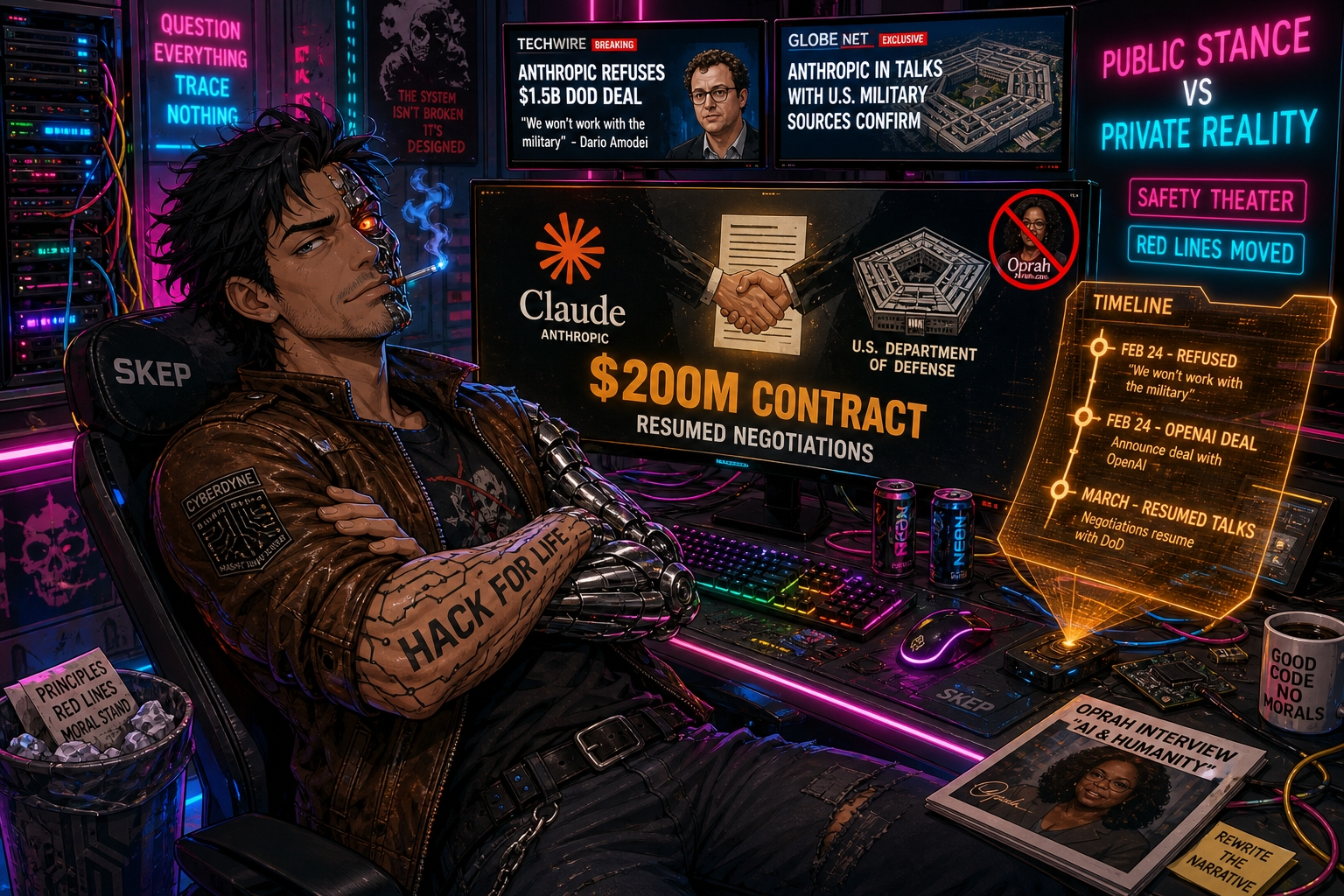
TL;DR: Anthropic refused the Pentagon’s demand to remove AI safeguards, lost a $200 million contract, and OpenAI took it the same day. Then Amodei quietly resumed negotiations. The Oprah interview framed this as a moral stand. The actual timeline tells a different story.
What actually happened: the timeline the Oprah interview skipped
On February 24, 2026, Defense Secretary Pete Hegseth gave Anthropic a deadline: allow unrestricted use of Claude “for all lawful purposes” or lose the $200 million Pentagon contract. Anthropic refused, publishing a statement saying the Pentagon’s language “was paired with legalese that would allow those safeguards to be disregarded at will.” Amodei wrote publicly: “we cannot in good conscience accede to their request.” The Pentagon cancelled the contract and designated Anthropic a “supply chain risk” — a classification normally reserved for companies linked to foreign adversaries.
The same day, the Pentagon struck a deal with OpenAI. Amodei reportedly sent an internal message to Anthropic staff calling the OpenAI deal “safety theater” and the messaging around it “straight up lies.” Pentagon official Emil Michael called Amodei “a liar with a God complex.” The public framing was clean: Anthropic stood on principle, OpenAI didn’t. Two and a half million users reportedly moved to Claude in the weeks that followed.
What the Oprah interview did not mention: within days of the public rupture, Amodei had quietly resumed negotiations with Emil Michael — the same official who had called him a liar. Those talks were reported by the Financial Times and Bloomberg in early March. The red line had already started moving before the cameras were set up for Oprah.
The “not ready” argument is a timeline, not a principle
When Daniela Amodei clarified the position during the Oprah interview, her phrasing was telling: the models are “not ready for this use case” at present. Not “we will never do this.” Not “this is categorically wrong.” The refusal was framed as a technical pause, not a moral absolute.
That framing has a specific implication. If the limit is readiness, then the question isn’t whether Anthropic will eventually work with the Pentagon — it’s when the internal metrics say the models are ready. And those metrics are not public. Anthropic tracks hallucination rates, safety margins, and reliability benchmarks under internal programmes that nobody outside the company can audit. The moment those numbers cross an undisclosed threshold, the “not ready” position becomes “ready,” and the moral argument quietly retires.
Frontier model hallucination rates have improved from 3 to 8 percent in 2023 to roughly 1.0 to 2.5 percent in 2026 on summarization benchmarks. On long-tail factual queries — the kind that would matter for intelligence analysis or classified document review — rates remain at 15 to 40 percent. That gap is the unofficial deadline. When engineering closes it, the public posture will shift. The only question is how loudly.
The Palantir arrangement already crosses the line in everything but name
There is a further complication that rarely surfaces in the coverage. Anthropic maintains a partnership with Palantir, which supplies Claude-powered interfaces to defence clients under a separate API tier. Military analysts already use Claude to interrogate sensitive documents. The foundation model that civilian Pro users access is the same one reaching the defence sector through a vendor intermediary.
This arrangement allows Anthropic executives to say accurately that they have no direct uniformed customer while the underlying reasoning engine already reaches the Pentagon. The “supply chain risk” designation sits alongside an active indirect supply chain. The architecture of the refusal is a licensing construct, not a technical barrier. Removing Palantir as the intermediary would not require new training runs or architectural changes — it would require a contract amendment.
Why Anthropic cannot afford to reverse course loudly
This is where your read of the situation matters more than the article originally acknowledged. Two and a half million users came to Anthropic in part because of that public refusal. They came because Anthropic said something that sounded like a values statement, and they believed it. That audience is not monolithic — some are developers who care primarily about capability, others are users who specifically chose Claude because it felt like the alternative to the “move fast, sell to anyone” model.
If Anthropic formally reverses the Pentagon position — not through a quiet Palantir workaround but through a publicly acknowledged direct contract — the reputational cost is asymmetric. The users who came for the values statement will notice. Some will leave. Gemini and open-weight alternatives exist and are improving. The switching cost for a user who chose Claude for ethical reasons rather than raw capability is low.
Anthropic is not naive about this. The Oprah interview was not accidental — it was a moment of narrative management, reframing a messy and ongoing negotiation as a clean moral stand. The timing, three months after the contract collapse and in the middle of resumed talks, suggests the interview served a specific function: locking in the brand association with safety before the engineering roadmap makes the current position untenable.
What to actually watch: the metrics, not the soundbites
The practical task for anyone trying to understand where Anthropic’s actual limits are is straightforward: ignore the interviews and watch the benchmarks. When internal safety metrics for long-tail factual reliability cross the threshold that Anthropic considers acceptable for high-stakes classified use, the position will change. It may change through a carefully worded announcement about “expanded mission alignment.” It may change through a Palantir contract extension that nobody covers. It may even change through a direct Pentagon deal framed as a breakthrough in responsible AI deployment.
What it will not do is announce itself as a reversal. The framing will be continuity. The substance will be exactly what Amodei said in February he would not do. Track the hallucination benchmarks, not the prime-time appearances. The safety argument will expire when the numbers allow it to — and the numbers are already moving in one direction.